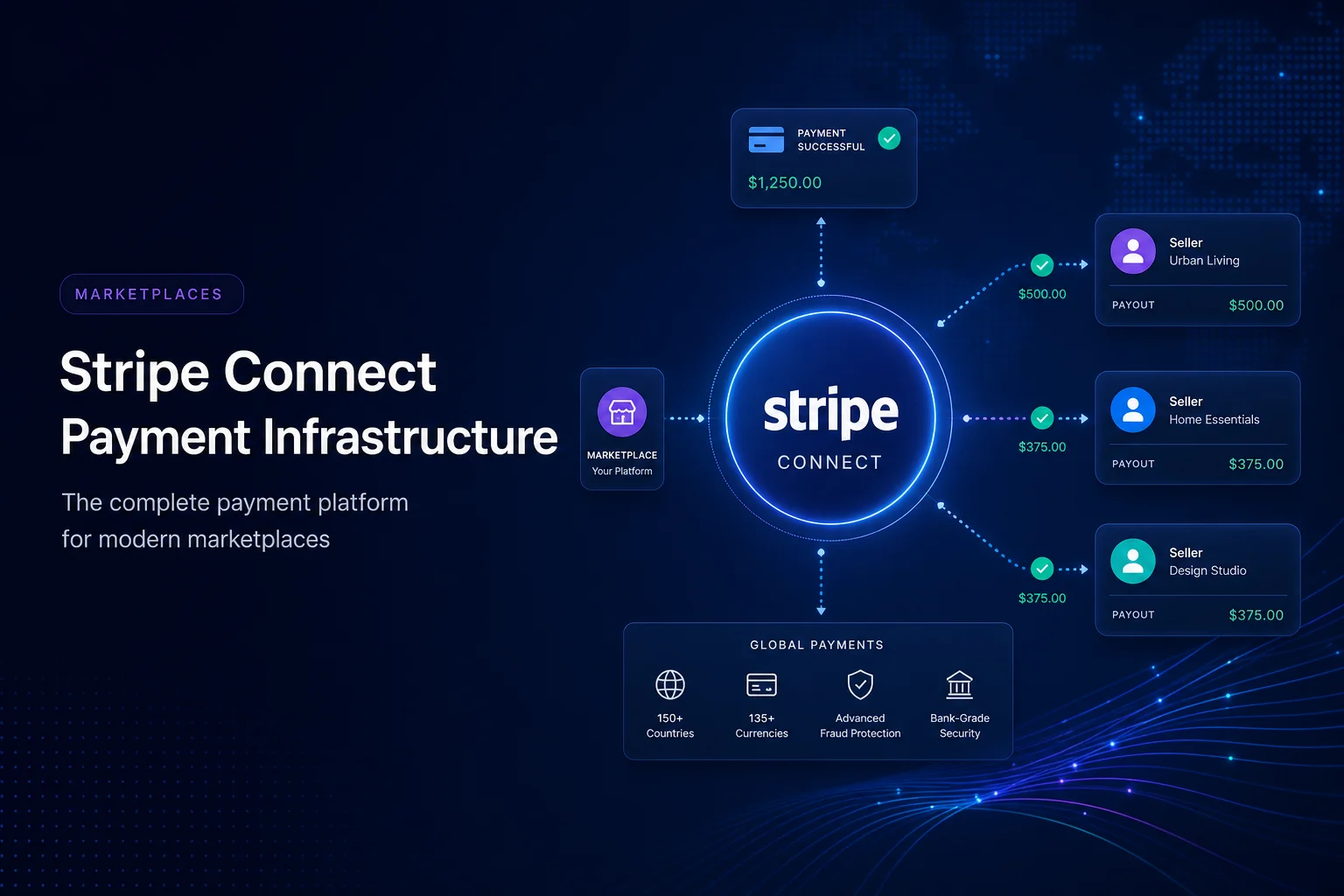
Stripe Connect isn’t just “another Stripe product.” It’s the infrastructure layer that powers Uber, Shopify, DoorDash, and thousands of other platforms. If your business is a marketplace, a SaaS with payouts, or any platform where money flows through you to someone else — Connect is the solution you’re looking for.
Website: stripe.com/connect
The Core Idea: Money from A to B Without You in the Chain
Traditional model: customer pays you → you pay seller/provider. You’re at the center, bearing compliance, taxes, refunds, and liability.
Connect changes this: Stripe makes you a platform through which money goes directly from payer to recipient. Your platform is just an intermediary taking a commission. Stripe handles everything else.
Key Features
Onboarding in 5 Minutes. Stripe provides a ready-made registration form for your sellers/providers (Connect Express). The person enters their data, Stripe verifies (KYC), and within 5 minutes they can accept payments. You don’t need to collect, store, or verify documents.
Three Integration Modes. Standard — full Stripe Dashboard for each user. Express — simplified interface without needing to log into Stripe. Custom — fully your UI, Stripe works on the backend. Pick based on your scenario.
Automatic Payouts. Set up a schedule — Stripe transfers money to sellers automatically. Daily, weekly, manual. 135+ countries and 45+ currencies.
Payment Routing. A customer pays $100 — you configure: $80 to the seller, $15 to the platform, $5 Stripe fee. Or more complex splits by product, geography, custom rules.
Compliance Out of the Box. Stripe handles: seller KYC/KYB, 1099 forms for the US, fraud monitoring, refund and chargeback management. For a platform, that’s thousands of saved hours on lawyers and compliance teams.
Who It Suits
Marketplaces. Product marketplaces (like Etsy), service marketplaces (like Uber), rental platforms (like Airbnb). Any model with a buyer and seller.
Crowdfunding Platforms. Kickstarter-like — fund collection with automatic distribution.
SaaS with Referral Programs. If your SaaS pays partners commissions, Connect automates payouts.
Freelance Platforms. Exchanges like Upwork — client pays freelancer through your platform, you take a percentage.
How to Integrate
Step 1. Register a Stripe account and activate Connect in settings.
Step 2. Choose onboarding type for sellers: Standard, Express, or Custom.
Step 3. Integrate via API or use Stripe’s ready-made components (Connect.js, Stripe Elements).
Step 4. Configure commissions, payout schedule, and payment routing.
Step 5. Test in a sandbox environment.
Full integration takes from 2 days (Express, ready platform) to 2 weeks (Custom, bespoke backend). Stripe’s documentation is among the best in the industry, with interactive examples.
What to Know Before Starting
You’re Still the Platform. Stripe doesn’t become the merchant. You remain responsible for customer relationships, support, and marketing. Stripe is only the payment infrastructure.
Geographic Limitations. Connect is available in 46 countries. If your market is outside those countries, you can’t use Connect.
Fees. Standard: 2.9% + $0.30 per transaction (US). Plus a separate fee for Connect accounts: $2/month per active account or a percentage of payout. Custom pricing for high-volume platforms.
Stripe Partner Program
Stripe’s Partner Program works differently from most affiliate programs. It’s not a “bring a customer, get a percentage” model. Format — for agencies and developers:
- You get Stripe Partner status after registration
- Clients you bring receive discounts on processing fees (up to $50K free processing)
- You receive: revenue share from referred clients’ transactions (rate negotiated)
- Additionally: co-marketing opportunities, priority support, early feature access
Stripe’s partner program is a long-term play for those implementing payment solutions for clients, not for content affiliates. If you’re a content site, focus on products built on top of Stripe (Paddle, LemonSqueezy) rather than Stripe itself.
Bottom Line
Stripe Connect is the gold standard for platform payment infrastructure. If you’re building a marketplace — there are virtually no alternatives. The only downside: the complexity isn’t in the API (it’s excellent) but in the legal and compliance issues that Connect doesn’t fully cover.
Choose Connect if: you’re building a platform with payments, need automated payouts, want to avoid compliance headaches.
Look at alternatives (Paddle, Adyen for Platforms) if: your platform is outside Stripe’s coverage countries, you need Merchant of Record rather than a payment gateway.