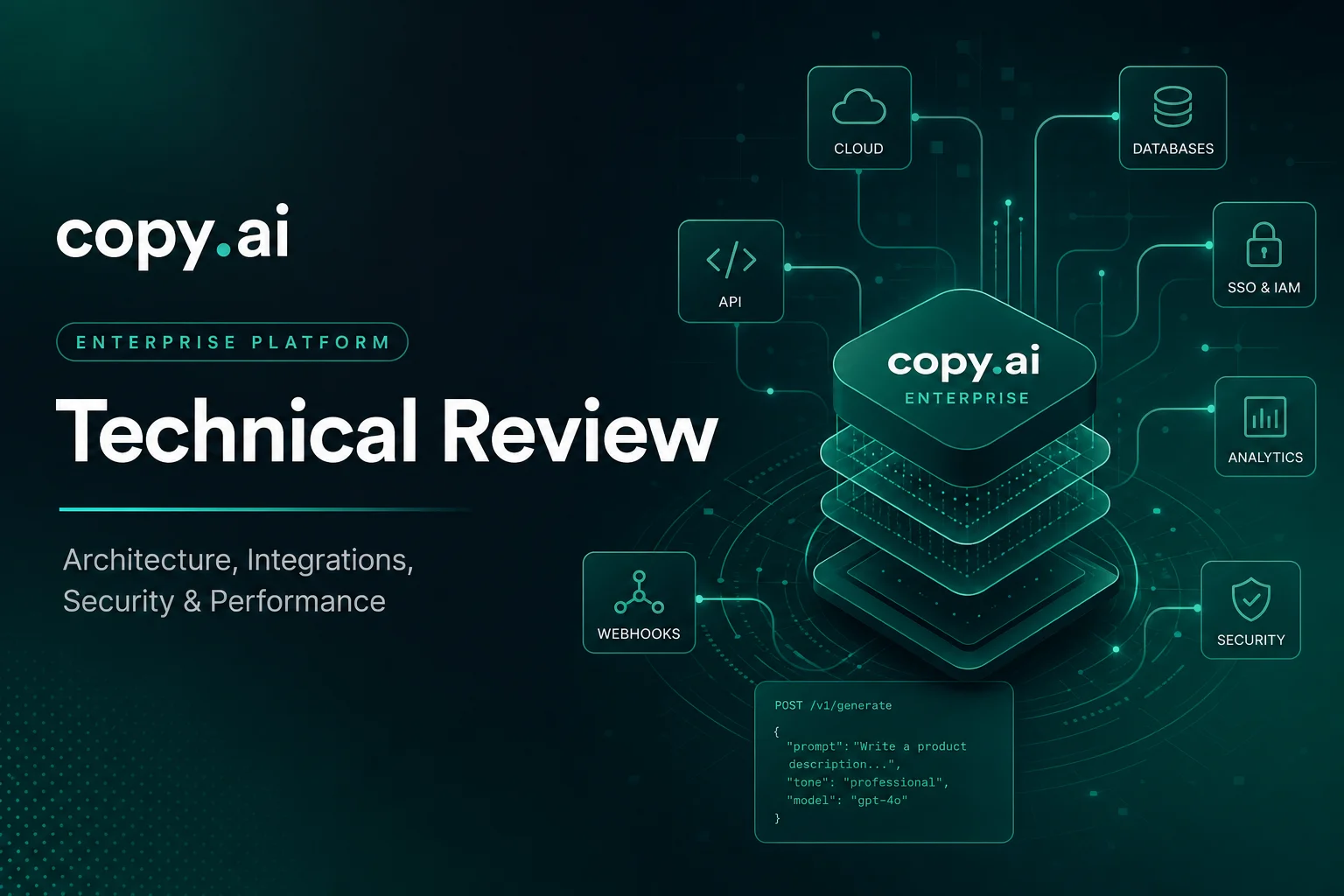
Copy.ai has evolved from an “Instagram post generator” to a full-fledged GTM AI platform. In 2026, it’s one of three surviving first-generation AI writers, and its technical stack deserves a dedicated breakdown — especially for those considering API integration or enterprise infrastructure deployment.
Website: copy.ai
Platform Architecture
Copy.ai is built on a hybrid model: proprietary fine-tuned models + multi-LLM orchestration. Under the hood — microservice architecture on Kubernetes, as the company’s CTO discussed at KubeCon 2025.
Model Layer
Unlike Jasper, which long relied on OpenAI API (before building its own models), Copy.ai went the orchestration route from the start:
- GPT-4o and GPT-5 (OpenAI) — for creative tasks, idea generation
- Claude 3.5/4 (Anthropic) — for structured documents and analysis
- Proprietary fine-tuned models — for specific GTM tasks: lead qualification, scoring, data enrichment
- Gemini 2.0 (Google) — for tasks requiring Google Workspace integration
Request routing happens automatically: the system identifies the task type and directs it to the optimal model. Technical implementation uses the Model Router pattern with fallback chains — if one model fails, the request goes to the next.
GTM AI — Not Just Copywriting
Copy.ai’s key architectural differentiator is the GTM AI (Go-To-Market) module. It’s not a text generator — it’s an automation platform for the entire GTM cycle:
- AI Lead Enrichment — enrich CRM leads with data from 20+ sources
- AI Prospecting — automatic generation of personalized outreach messages
- AI Workflows — chains: enrichment → scoring → generation → sending
- AI CRM Actions — bidirectional integration with Salesforce and HubSpot
API and Integrations
REST API (v3)
Documented REST API with endpoints:
- /v3/workflows — launch AI Workflows
- /v3/generate — text generation with brand voice context
- /v3/enrich — data enrichment
- Webhook notifications for long-running task completion (async mode)
Authentication: Bearer token + API key rotation. OAuth 2.0 support for enterprise clients.
Rate limits: 100 RPM on Pro, 500 RPM on Enterprise. Custom limits for high-volume.
SDK: Official SDKs for Python, Node.js, and TypeScript. Unofficial — Go and Ruby.
Salesforce and HubSpot
Bidirectional sync: Copy.ai reads CRM data, enriches it, generates content, and writes results back. Integration via native connectors, not Zapier — lower latency.
Security and Infrastructure
- SOC 2 Type II — verified security audit
- GDPR compliance — data stored in EU data centers for European clients
- Encryption at rest and in transit — AES-256 + TLS 1.3
- SSO and SAML — for enterprise plans
- Audit logs — all user actions logged, available for compliance checks
- Data retention policy — customizable data retention periods, including auto-deletion after N days
Scaling
Copy.ai uses horizontal scaling via Kubernetes. During peak loads (product launches, end-of-quarter), additional pods automatically spin up. Average generation latency — 3–8 seconds, complex workflows — up to 30 seconds.
Enterprise clients get dedicated tenant — isolated installation with guaranteed resources. Pricing discussed individually, starting at $4,000/month.
Affiliate Program: Technical Aspect
Copy.ai operates through PartnerStack. Partner integration:
- Tracking API: embed tracking in your app via PartnerStack API
- Webhook notifications: for new conversions, cancellations, status updates
- Commission: 20% recurring (for the customer’s lifetime)
- Cookie duration: 90 days
- Minimum payout: $25 via PayPal or ACH
Technically, the affiliate program is standard — referral link with UTM parameters. No server-side integration required for partners.
Final Assessment
Architecture Strengths:
- Multi-LLM orchestration with smart routing — unique advantage
- GTM AI Workflows — not just text, but sales automation
- Mature API with decent rate limits and SDKs
Limitations:
- Dedicated tenant is expensive (from $4,000/month)
- No on-premise deployment
- 20% affiliate rate — not market-leading
For Developers: The API is mature, well-documented, with reasonable rate limits. Integration takes a couple of days. GTM AI Workflows — a unique opportunity for building automations.
For Business: If you’re already on Salesforce or HubSpot and want AI-powered sales automation — Copy.ai provides what ChatGPT and Claude don’t. The price is justified for teams of 10+.