What Is Adyen
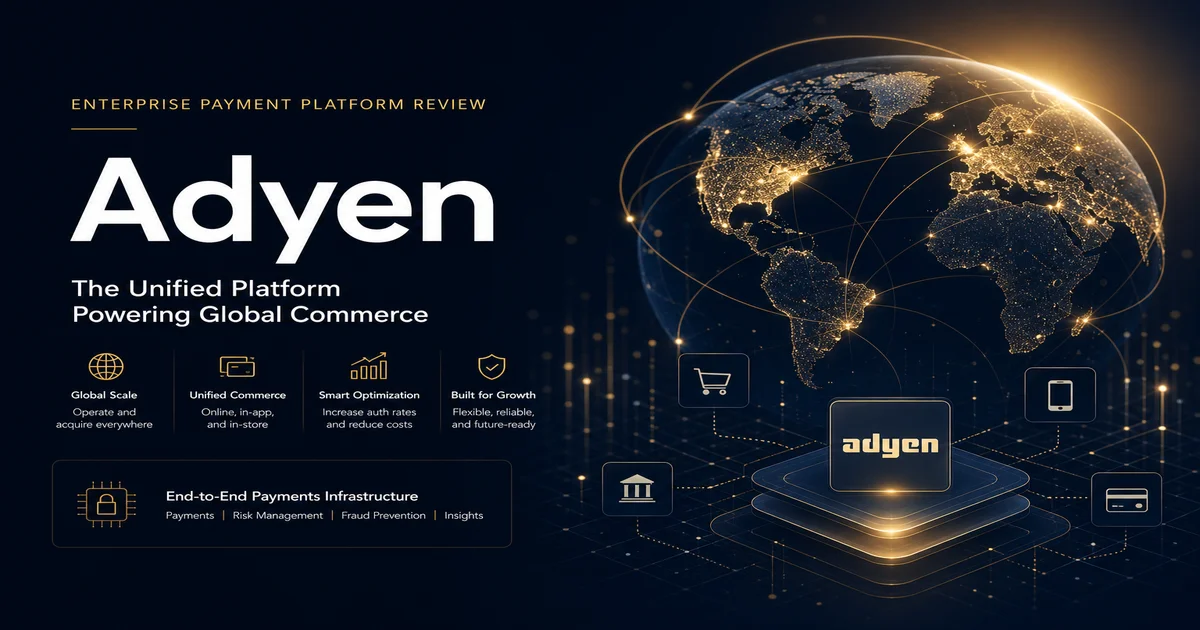
Adyen (pronounced “eye-den”) is a Dutch enterprise-grade payment platform serving Spotify, Uber, Microsoft, Booking.com, and thousands of global companies. Founded in 2006. Unlike Stripe, which grew from startups, Adyen targeted large businesses from day one.
Official website: adyen.com
Adyen isn’t just an acquirer. It’s the full stack: gateway + acquiring + risk management + payment analytics. All on a single platform, without bouncing between providers.
Key Features
Single Platform
Adyen’s main differentiator. Instead of assembling a zoo of payment gateway, acquirer, fraud provider, and analytics tool, Adyen provides everything in one contract. This reduces operational costs by 20-30% according to the company.
Local Acquiring
Adyen holds acquiring licenses in 40+ countries. This means:
- Higher approval rates (fewer declined transactions)
- Local payment methods: iDEAL in the Netherlands, Bancontact in Belgium, WeChat Pay in China
- Lower cross-border transaction fees
Revenue Accelerate
AI system that optimizes payment routing in real-time. Selects the acquirer with the highest approval rate for each transaction. Claimed revenue uplift: 1-3%.
Risk Management (RevenueProtect)
Built-in fraud monitoring with machine learning. Uses data from the entire Adyen network (processing thousands of merchants’ transactions) to detect anomalies. Risk rules can be configured without developer involvement.
Payment Methods
250+ methods in 150+ currencies. Beyond Visa/MC/Amex cards: BNPL (Klarna, Afterpay), crypto gateways, local bank transfers, digital wallets (Apple Pay, Google Pay, PayPal).
Data Platform
Built-in analytics with reporting on revenue, declines, payment methods, and fraud. Data accessible via dashboard or API. Integration with Tableau, Power BI.
Pricing
Adyen doesn’t publish fixed rates — operates on Interchange++ model. For reference:
- Cards (EU): Interchange + €0.10-0.20 + 0.3-0.6%
- Cards (US): Interchange + /bin/zsh.10-0.15 + 0.3-0.6%
- Local methods: 0.2-1% of amount
- Minimum volume: ~K/mo (unofficial)
Adyen isn’t suitable for small business — the entry threshold is high. This is a tool for companies processing M+/mo.
Adyen Partnership Program
Unlike Stripe and Paddle, Adyen doesn’t have a mass-market affiliate program. Partnerships are built around three models:
1. Platform Partnership
For SaaS platforms and marketplaces. You embed Adyen into your product and earn revenue share on your clients’ payment processing. Terms are individual, typically 0.05-0.1% of volume.
2. Technology Partnership
For developers and system integrators. You help implement Adyen for clients and earn commission from Adyen. Certification required.
3. Referral Partnership
Limited program for consultants and agencies. Bring enterprise clients — earn a fixed bonus or % of first-year volume. Terms negotiated individually, typical bonus — ,000-,000 per signed contract.
For Affiliate Marketing:
Adyen is a weak choice. No mass affiliate program with cookie tracking. If you’re a blogger/YouTuber — look at Stripe or Paddle. But if you’re an enterprise fintech consultant — a direct contract with Adyen could bring significantly more in one-time payments.
Key Strengths
- Single contract. One provider for all payment functions — less headache.
- Local acquiring in 40+ countries. Higher approval rates, lower fees.
- 250+ payment methods. Absolute record among payment platforms.
- Revenue Accelerate. AI routing optimization genuinely generates revenue.
- Enterprise clients. If Uber and Microsoft trust it — reliability is proven.
Weaknesses
- Not for small business. High minimum volume, no self-service.
- Complex integration. API is powerful but requires serious development work.
- No mass affiliate program. Bloggers and affiliates have nothing to do here.
- Pricing opacity. Real rates unknown without negotiations.
- Support. Good, but not for small merchants — enterprise priority.
Comparison
| Criteria | Adyen | Stripe | Checkout.com |
|---|---|---|---|
| Min. Volume | ~K/mo | /bin/zsh | ~K/mo |
| Local Acquiring | 40+ countries | 10+ countries | 20+ countries |
| Payment Methods | 250+ | 135+ | 150+ |
| Affiliate Program | Enterprise | Mass market | Enterprise |
| For Startups | No | Yes | No |
Who Should Use It
Ideal for:
- Enterprise companies with international payments
- Marketplaces and SaaS platforms
- Retailers processing M+/mo
- Businesses wanting to consolidate from multiple payment providers
Not for:
- Startups and small businesses (get Stripe)
- Bloggers doing affiliate marketing
- Those wanting a plug and play solution
Verdict
Adyen is the payment platform for those who’ve already grown. If your business processes M+/mo across multiple countries — Adyen will almost certainly reduce your payment costs and increase approval rates. But the entry barrier is high: small companies should look at Stripe or Paddle. Affiliate program only exists for enterprise consultants — mass-market affiliates should look elsewhere.
Rating: ★★★★☆ (4/5, minus a point for opacity and small business inaccessibility)