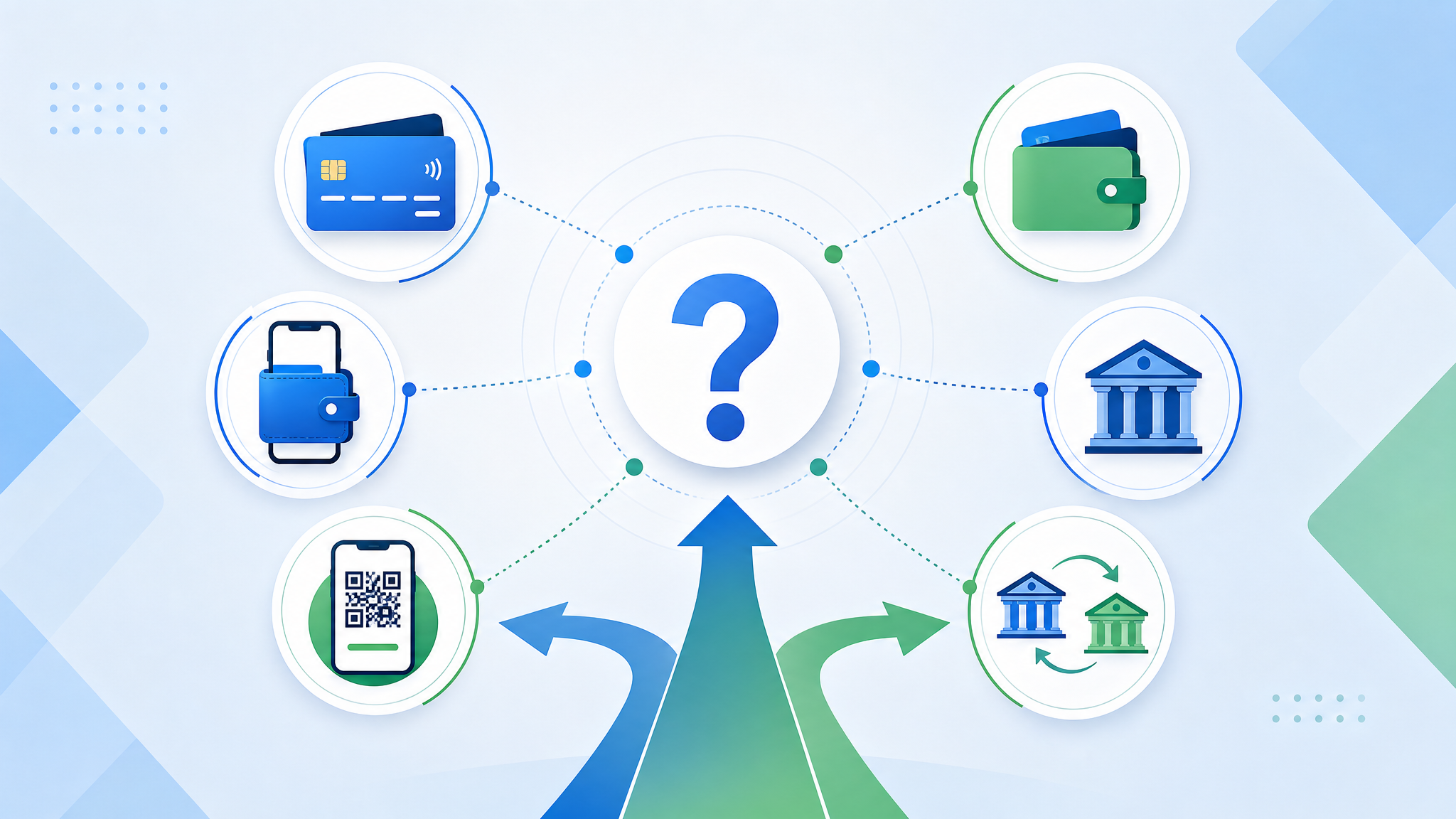
Choosing a payment system is one of the most important technical decisions for a business. It affects checkout conversion, payout speed, tax risks, and operational costs. A mistake at this stage can cost thousands of dollars in lost revenue.
Let’s break down three payment acceptance models and the selection criteria.
Three Payment Acceptance Models
1. Payment Gateway
You integrate a payment gateway directly. Money flows from the buyer through the gateway to your bank account. You’re responsible for everything: taxes, refunds, security, payer support.
Examples: Stripe, PayPal, Adyen, Braintree.
Pros:
- Minimal commission (2–3%)
- Full control over checkout
- Direct access to funds
Cons:
- You are the merchant of record with all obligations
- Must pay and report taxes in every country
- PCI DSS compliance required
- Refunds and chargebacks are your headache
Best for: companies with legal entities in sales countries, ready for tax burden.
2. Merchant of Record (MoR)
The service itself is the seller from a legal standpoint. It accepts payments, pays taxes, handles refunds, and transfers net revenue to you.
Examples: Paddle, LemonSqueezy, Gumroad, FastSpring.
Pros:
- Zero tax hassles
- No legal entity needed in each country
- Automatic compliance (GDPR, VAT, sales tax)
- Refunds and chargebacks handled for you
Cons:
- Higher commission (5–12%)
- Less control over checkout
- Dependency on MoR provider policies
- Delayed payouts (week–month)
Best for: freelancers, indie developers, international SaaS without local legal entities.
3. SaaS Billing
A combination of payment gateway, subscription management, billing, and analytics. Purpose-built for the SaaS model.
Examples: Chargebee, Recurly, Zuora.
Pros:
- Subscription management built in
- Dunning management (automatic handling of failed cards)
- Flexible pricing models
- Integration with tax engines
Cons:
- Platform on top of a payment gateway = double commission
- More complex integration
- Overkill for non-SaaS businesses
Best for: SaaS companies with subscriptions, especially at $10K+ MRR.
Key Selection Criteria
Customer Geography
If 80% of customers are in one country — a local solution works (Stripe + local bank). If customers are spread worldwide — MoR or a global gateway with multi-currency support.
Average Transaction
- Micropayments ($1–10): fees matter. Compare the fixed portion: $0.30 on Stripe vs $0.10 on Square.
- Mid-range ($20–200): standard terms. Checkout conversion matters more than a percentage point.
- Large amounts ($500+): priority is security. Fraud detection, 3D Secure, manual verification.
Business Model
- One-time sales: checkout simplicity. Payment links, fast integration.
- Subscriptions: recurring billing, dunning, upgrade/downgrade, trial management.
- Marketplaces: split payments, escrow, seller KYC, commissions.
Legal Entity Availability
No legal entity in the sales country — only MoR (Paddle, LemonSqueezy, Gumroad). With a legal entity — all options open up.
Solution Comparison Table
| Service | Model | Commission | Best for |
|---|---|---|---|
| Stripe | Gateway | 2.9% + $0.30 | Online SaaS with dev team |
| Paddle | MoR | 5% + $0.50 | International B2B SaaS |
| LemonSqueezy | MoR | 5% + $0.50 | Indie SaaS and digital goods |
| Gumroad | MoR | 10% | Courses, templates, digital products |
| Square | Gateway + POS | 2.6–2.9% | Retail + online |
| Chargebee | Billing | from $599/mo + gateway | SaaS with $50K+ MRR |
| PayPal | Gateway | 2.9% + $0.30 | Quick start, brand recognition |
| Wise | Transfers | from 0.35% | Direct international payments |
Common Mistakes
❌ Choosing MoR when you could use a gateway. If you have a legal entity and an accountant — Stripe saves 3–5% on turnover.
❌ Choosing a gateway without tax considerations. Selling into the EU without VAT registration? Prepare for problems. MoR removes this risk.
❌ Tying yourself to a single processor. Always have a backup. Stripe can freeze your account — without an alternative gateway, the business stops.
❌ Ignoring dunning. For subscription businesses, automatic failed payment recovery returns 5–15% of revenue.
❌ Not testing mobile checkout. 60%+ of internet traffic is mobile. If paying is inconvenient on a phone, you’re losing conversions.
Selection Checklist
- Defined your business model (one-time / subscriptions / marketplace)?
- Know your customer geography?
- Do you have a legal entity in sales countries?
- What’s the average transaction size?
- Which payment methods do customers need?
- Ready for PCI DSS compliance?
- Need automated dunning?
- Have a Plan B in case of account freeze?
Conclusion
There is no “best” payment system — only the one that fits your business. The rule is simple:
- No legal entity → MoR (Paddle, LemonSqueezy, Gumroad)
- Legal entity + developers → Stripe
- Offline + online → Square
- SaaS with $10K+ MRR subscriptions → Chargebee or Recurly
- Cross-border frequently → Wise for transfers, MoR for sales
A payment system is not an area to skimp on. The percentage point saved in commission won’t cover the lost customers who found it inconvenient to pay.
Official Stripe Website Official Paddle Website Official LemonSqueezy Website Official Gumroad Website