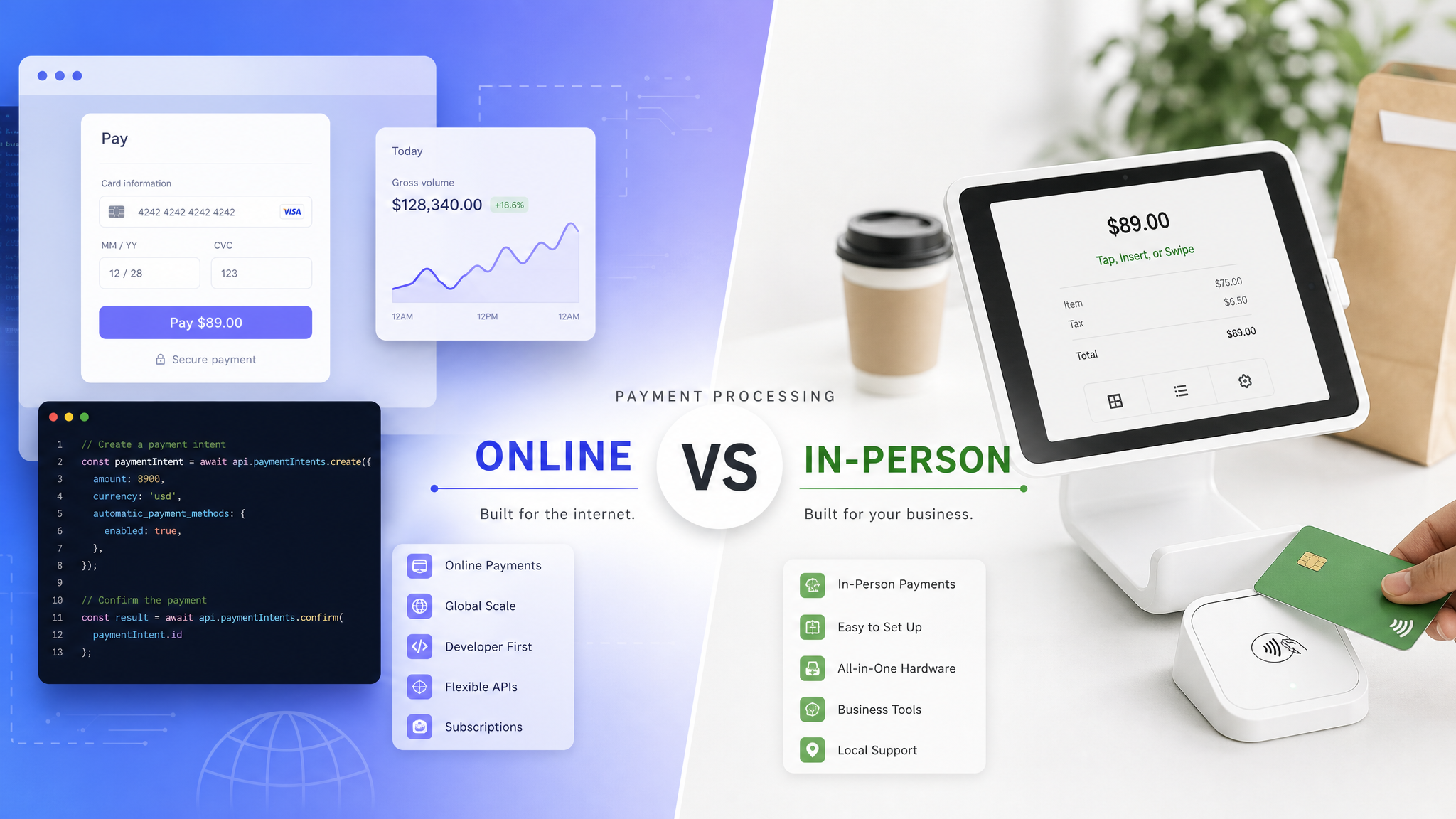
Stripe and Square are the two biggest names in payment processing. Both were founded in the late 2000s, both became public companies with multi-billion-dollar market caps. But they have fundamentally different philosophies: Stripe is for developers and online business, Square is for retail and offline.
Philosophy and Positioning
Stripe is a platform for the internet economy. Created by developers for developers: clean API, excellent documentation, full programmability. If your business is a website or an app, Stripe gives you maximum flexibility in how the payment process looks and works.
Square is an ecosystem for real-world business. It grew from a card reader for iPhone and is still strong in offline: terminals, registers, receipts, inventory management. Online payments in Square came later as a complement to the offline core.
Payment Processing
Stripe:
- Fully programmable checkout via API
- Stripe Elements — embeddable UI components
- Stripe Checkout — ready-made payment page
- Payment Links without a website
- Subscriptions and recurring billing built in
- 135+ currencies and 40+ payment methods
Square:
- POS terminals for in-person card acceptance
- Square Online — simple online store builder
- Payment links and invoices
- Integration with offline receipts and inventory
- Fewer payment methods than Stripe
- Weaker, less flexible API
Fees
| Payment Type | Stripe | Square |
|---|---|---|
| Online (cards) | 2.9% + $0.30 | 2.9% + $0.30 |
| In-person (cards) | 2.7% + $0.05 | 2.6% + $0.10 |
| International | +1.5% | unavailable |
| ACH/bank transfers | 0.8% (max $5) | none |
| Invoices | 2.9% + $0.30 | 3.3% + $0.30 |
Stripe wins on international payments and bank transfers. Square is slightly cheaper on in-person transactions. For online stores, the difference is minimal.
API and Integrations
Stripe: the gold standard for fintech APIs. Clean documentation, SDKs for all popular languages, open libraries, huge community. Any developer can integrate Stripe in a day.
Square: functional API, but less elegant. SDKs available for major languages, documentation is satisfactory. Requires more effort for complex integrations.
If your product is software with a custom checkout, Stripe is irreplaceable. If you’re opening a coffee shop — Square.
Affiliate Programs
Stripe Partner Program: for platforms, marketplaces, and agencies. Commission on turnover from referred merchants. Strong track for SaaS platforms embedding Stripe.
Square Partners: for developers and agencies implementing Square for clients. Commission on referred accounts. Emphasis on offline business.
What to Choose
Stripe — best choice if:
- Your business is fully online
- You need custom payment integration
- You sell subscriptions (SaaS, memberships)
- You have international customers
- Your product is a platform or marketplace
Square — best choice if:
- You have a physical store, café, or restaurant
- You combine offline and online sales
- You need a ready-made POS solution
- An ecosystem matters (terminals + inventory + payroll)
Summary
Stripe and Square don’t so much compete as complement each other. Stripe — for digital-first business. Square — for brick-and-mortar. If you’re a SaaS startup — Stripe. If you’re opening a store — Square. Many companies eventually use both: Stripe for the website, Square for the retail location.