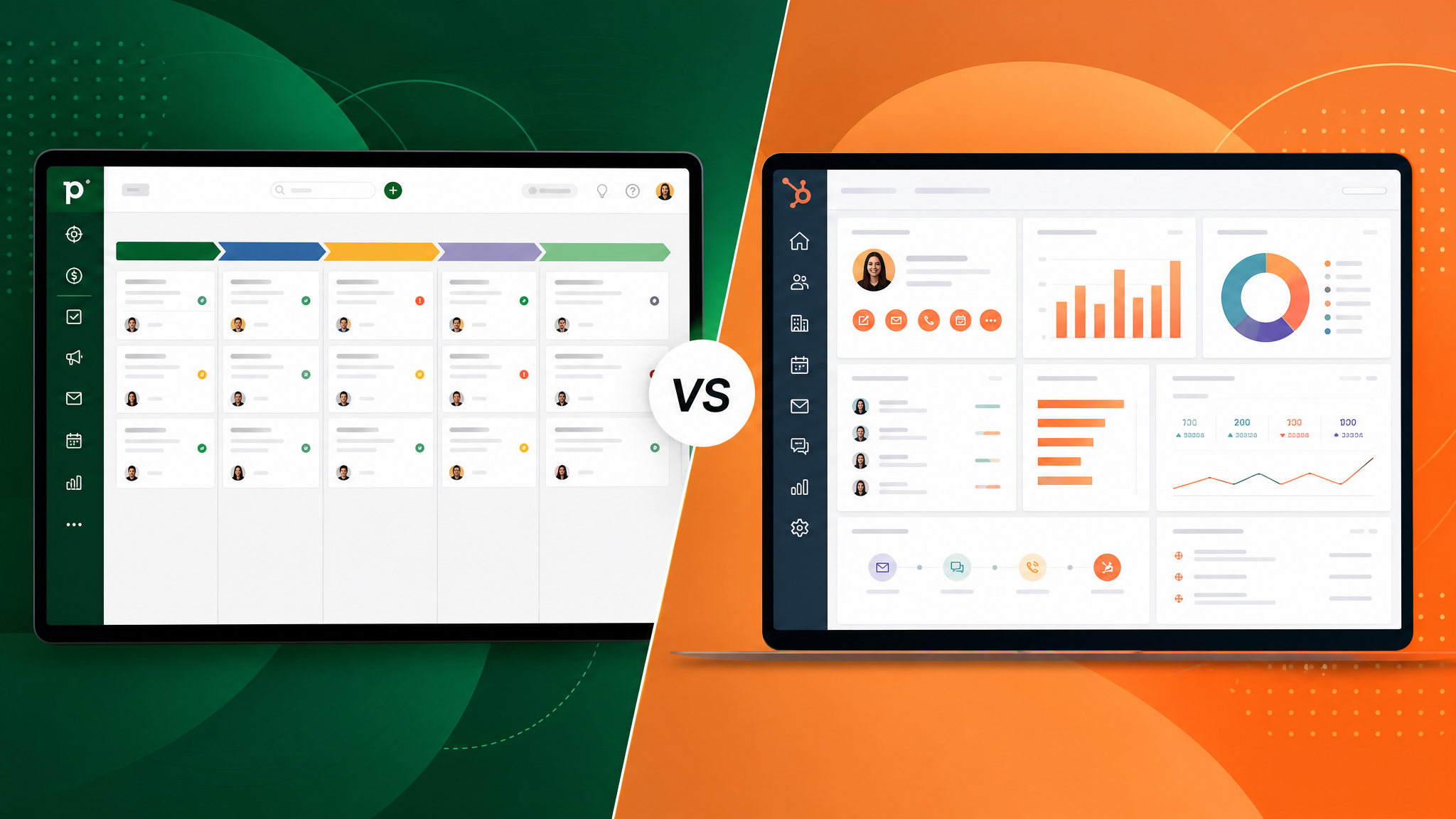
Pipedrive vs HubSpot — Two Sales Philosophies in One Comparison
Choosing a CRM often comes down to one question: buy a tool built exclusively for sales, or a platform that also handles marketing and support? Pipedrive and HubSpot are two market leaders with diametrically opposed approaches to this question.
Sites: pipedrive.com | hubspot.com
Different DNA
Pipedrive was built by salespeople for salespeople from day one. Their tagline literally says: “CRM created by salespeople, for salespeople.” The interface is minimalistic. At the center — a deal pipeline: drag cards through stages until you close the sale. Everything else is auxiliary.
HubSpot started with marketing and only later grew CRM modules. Today it’s an ecosystem of multiple “hubs”: Sales Hub, Marketing Hub, Service Hub, CMS Hub. You can take just the free CRM, or buy additional modules — or assemble the full stack.
Comparison Table: Pipedrive vs HubSpot
| Feature | Pipedrive | HubSpot |
|---|---|---|
| Free Plan | ❌ (14-day trial) | ✅ Free CRM |
| Entry Paid | $14/user/month (Essential) | $20/user/month (Sales Hub Starter) |
| Mid-tier | $49/user/month (Professional) | $90/user/month (Sales Hub Pro) |
| Marketing Campaigns | Built-in email campaign, LeadBooster (extra $39) | Full Marketing Hub (from $20/month) |
| AI Features | AI Sales Assistant, email analytics | Breeze Prospecting Agent, predictive scoring |
| Sales Pipeline | Visual, drag-and-drop, up to 5 pipelines | Customizable, stages with automation |
| Integrations | 500+ | 2,000+ |
| Telephony | Built-in | Built-in |
| Support | 24/7 (on Power and Enterprise) | Basic support + community |
How the Pipeline Works
Pipedrive is obsessed with the sales pipeline. Dragging a deal from stage to stage is literally the entire interface. The system itself reminds you a deal is “rotting” without movement — the Deal Rotting feature. For a manager who wants to see only sales and nothing but sales, this is ideal.
HubSpot offers a more flexible but also more complex pipeline. Deals can be linked to contacts, companies, support tickets. Automated actions are triggered not only within the pipeline but also when a customer interacts with the website or email campaigns. This isn’t just a CRM — it’s a unified customer view from first click to post-purchase service.
Marketing: Own Ecosystem vs External Add-on
Key difference. Pipedrive provides basic email marketing and offers LeadBooster — a lead generation tool through chatbots and web forms, but for an additional $39 per month. For serious marketing, you’ll need to connect Mailchimp or ActiveCampaign.
For HubSpot, marketing is part of its DNA. Landing pages, email campaigns, SEO tools, blog platform, social media — all in one place. Though Marketing Hub Professional starts at $800/month, so “built-in” doesn’t mean “free.”
Price for a 5-Person Team
- Pipedrive Professional: $245/month — you get a professional CRM with AI assistant, forecasting, email tracking.
- HubSpot Sales Hub Professional: $450/month — add to that Breeze AI for lead scoring, conversational analytics, and deeper automation. Plus $1,500 onboarding.
The difference is nearly double. At the same time, Pipedrive on Professional already offers functionality comparable to HubSpot Pro — 150 reports per user, up to three teams, AI tools for email.
Verdict
Pipedrive — if you sell. A team of 5-50 people, classic B2B sales, calls, meetings, average deal cycle from a week to three months. You want a CRM that doesn’t distract with extras, just helps close more deals. Best price/features ratio in the “pure” CRM segment.
HubSpot — if you grow. A startup or company where sales are inextricably linked with marketing. You need a unified platform for attracting, converting, and retaining customers — with a blog, campaigns, SEO, and full-funnel analytics. Start with the free CRM, add modules as you grow.
Official websites: pipedrive.com, hubspot.com In short: Pipedrive is a surgeon-salesperson’s scalpel. HubSpot is a Swiss Army knife for the whole company.Official websites: pipedrive.com, hubspot.com