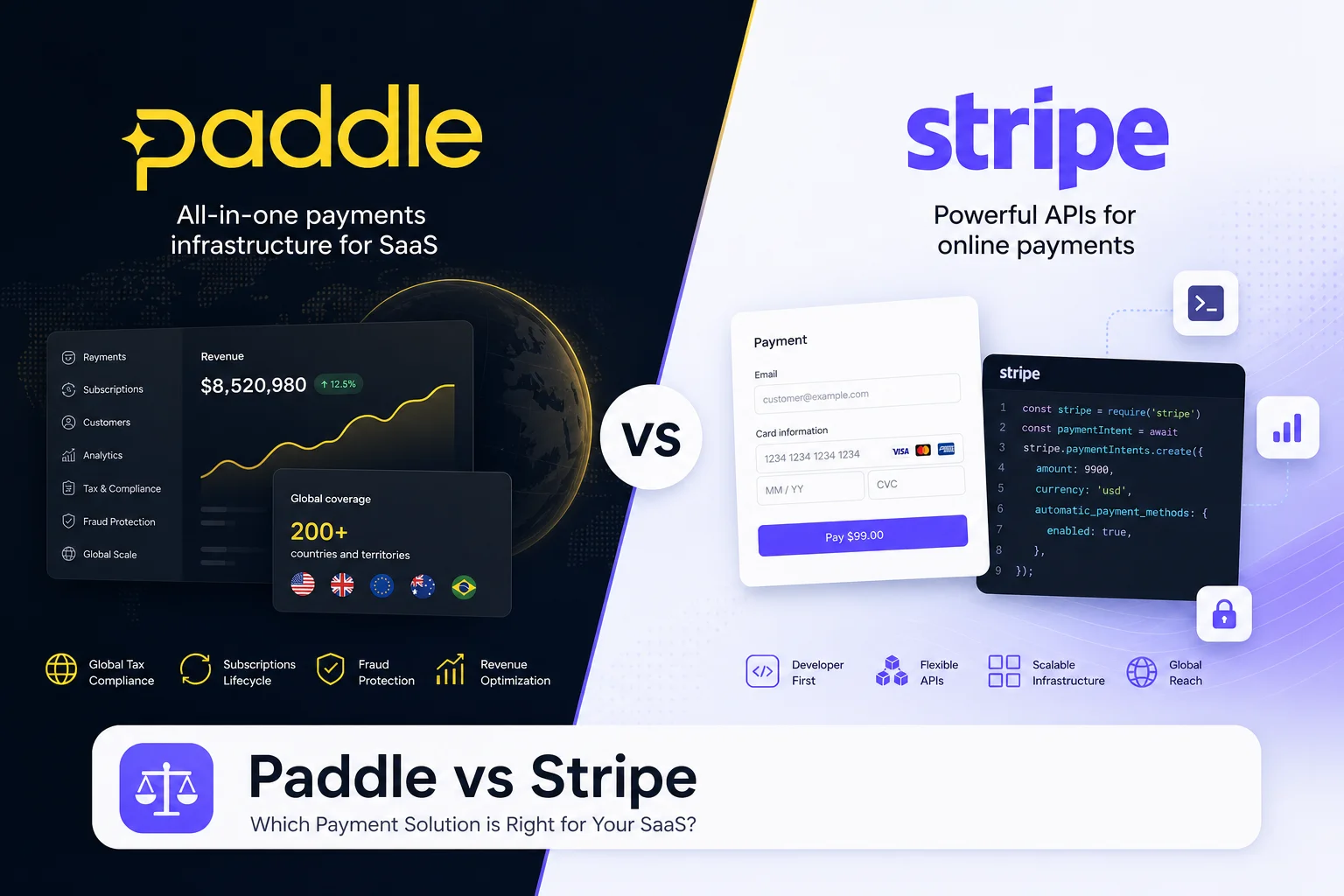
Paddle vs Stripe: The Legal Chasm Between MoR and Payment Gateway
Paddle and Stripe are often compared as “payment systems,” but from a technical and legal perspective, they are fundamentally different products. Stripe is a payment gateway (you sell). Paddle is a Merchant of Record, MoR (Paddle sells on your behalf).
Sites: paddle.com | stripe.com
This difference cascades into consequences: from tax obligations to API design. Let’s break it down in detail.
Legal Model: MoR vs Payment Gateway
Stripe (Payment Gateway):
- Your company is the Merchant of Record
- You’re responsible for: VAT/GST collection and remittance, invoicing, compliance, chargeback disputes
- You pay taxes in every country where you have customers
- For SaaS, this means VAT MOSS registration in Europe, tracking economic nexus in the US (each state separately), and GST in dozens of countries
Paddle (Merchant of Record):
- Paddle is the legal seller to your customers
- Paddle handles: VAT, GST, invoices, compliance, chargeback handling
- You receive a payout from Paddle as a single counterparty
- You have no tax obligations to end customers
- For SaaS: one line in your accounting instead of tax registrations in 30+ countries
Practical difference: at $50K MRR in Europe, tax compliance through Stripe requires VAT registration in 27 EU countries or using Union OSS. Through Paddle — zero registrations.
API and Technical Integration
Both platforms offer REST APIs with good documentation, but the approaches differ.
Stripe API:
- Philosophy: “building blocks” — Payments, Billing, Connect, Tax, Radar, each with its own API
- 15+ endpoint categories, deep customization
- Webhook events are granular: payment_intent.created, payment_intent.succeeded, charge.refunded — hundreds of events
- SDKs for 7 languages: Ruby, Python, PHP, Java, Node, Go, .NET
- Interactive documentation: test requests directly in the browser
- Stripe CLI for local webhook testing
Paddle API:
- Philosophy: “all-in-one” — single API for payments, subscriptions, invoicing
- Fewer endpoint categories, configuration through Paddle Dashboard
- Webhook events are more aggregated: subscription.created, transaction.completed
- SDK: Node.js (official), PHP, Python (community)
- Documentation: complete but less interactive than Stripe
- Sandbox with full simulation
Subscription Integration Example:
// Stripe (Node.js) — direct management
const subscription = await stripe.subscriptions.create({
  customer: 'cus_xxx',
  items: [{ price: 'price_xxx' }],
  payment_behavior: 'default_incomplete',
  expand: ['latest_invoice.payment_intent'],
});

// Paddle (Node.js) — via transaction
const transaction = await paddle.transactions.create({
  items: [{ priceId: 'pri_xxx', quantity: 1 }],
  customerId: 'ctm_xxx',
  customData: { internal_user_id: '42' },
});
Difference: Stripe gives more control (you manage every step of the payment flow). Paddle takes on more (less code for typical scenarios).
Taxes: The Main Argument for Paddle
This is Paddle’s strongest selling point. Let’s compare the tax burden on a SaaS developer.
Scenario: SaaS, $10K MRR, customers in 15 countries.
Through Stripe:
- VAT MOSS registration (EU): mandatory
- GST registration in Asian countries: as needed
- US Sales Tax: tracking economic nexus by state
- Accountant: $200–500/month for tax reporting
- Risk: VAT calculation error → fine up to €10K in Germany
Through Paddle:
- Paddle calculates, collects, and remits all taxes automatically
- You receive a payout minus taxes
- Accountant: 1 line “revenue from Paddle”
- Risk: Paddle makes an error → Paddle is liable
For non-US/EU residents: Paddle saves not just money but also nerves. Tax compliance in dozens of jurisdictions isn’t what a SaaS founder wants to spend time on.
Fees: Where It’s Cheaper
Stripe:
- Standard: 2.9% + $0.30 (US, EU)
- International cards: +1.5%
- Stripe Billing: +0.5% or 0.8% recurring
- Stripe Tax module: +0.5% (optional)
Paddle:
- Standard: 5% + $0.50
- Includes: MoR, taxes, compliance, chargeback handling
- At $50K+ volume: individual rates (down to 3.5–4%)
Math at $10K MRR:
- Stripe: 2.9% + Stripe Billing 0.5% + Stripe Tax 0.5% = 3.9% effective rate + accountant $300/month = $3,900/year
- Paddle: 5% = $6,000/year (no accountant needed)
- Difference: $2,100/year in Stripe’s favor — but without accounting for tax risks and compliance time
Decision: don’t just count percentages. Count the cost of your time and accountant. For a solo founder, Paddle often comes out cheaper in total cost of ownership.
Affiliate Programs
Stripe Partner Program:
- Revenue share from referred clients’ transactions (rate negotiated)
- Focus on agencies and developers
- Co-marketing, priority support
Paddle Partner Program:
- 20% recurring commission (while client pays)
- Average Paddle customer ticket: $50–200/month
- Cookie window: 90 days
- Payouts: from $50, PayPal/bank transfer
- Available through PartnerStack
Affiliate Verdict: Paddle is more convenient for content affiliates. 20% recurring at a typical $100/month client = $240/year per customer. Stripe is more for agency partners.
When to Choose What
Choose Paddle if:
- You’re a solo founder or small team
- You have customers from 10+ countries
- You don’t want to deal with tax compliance
- You sell a digital product (SaaS, licenses, courses)
- Your accountant doesn’t specialize in international taxes
Choose Stripe if:
- You have a dedicated finance team
- You need full control over the payment flow
- Your product requires custom payment logic (marketplaces, Connect)
- You have high volume ($500K+/year) — Stripe’s custom rates are lower
- You need specific Stripe products: Atlas, Capital, Issuing
Hybrid approach: use both. Paddle for self-serve sales, Stripe for enterprise contracts and complex scenarios. Many SaaS companies do exactly this.
Verdict
Paddle and Stripe aren’t competitors in the full sense. They’re tools for different stages of SaaS development. Paddle removes legal and tax headaches. Stripe gives maximum control and better rates at scale.
For 80% of indie developers and small SaaS teams, Paddle is the sensible default choice. Switching to Stripe makes sense at $50K+ MRR, when commission savings outweigh the cost of an internal compliance team.