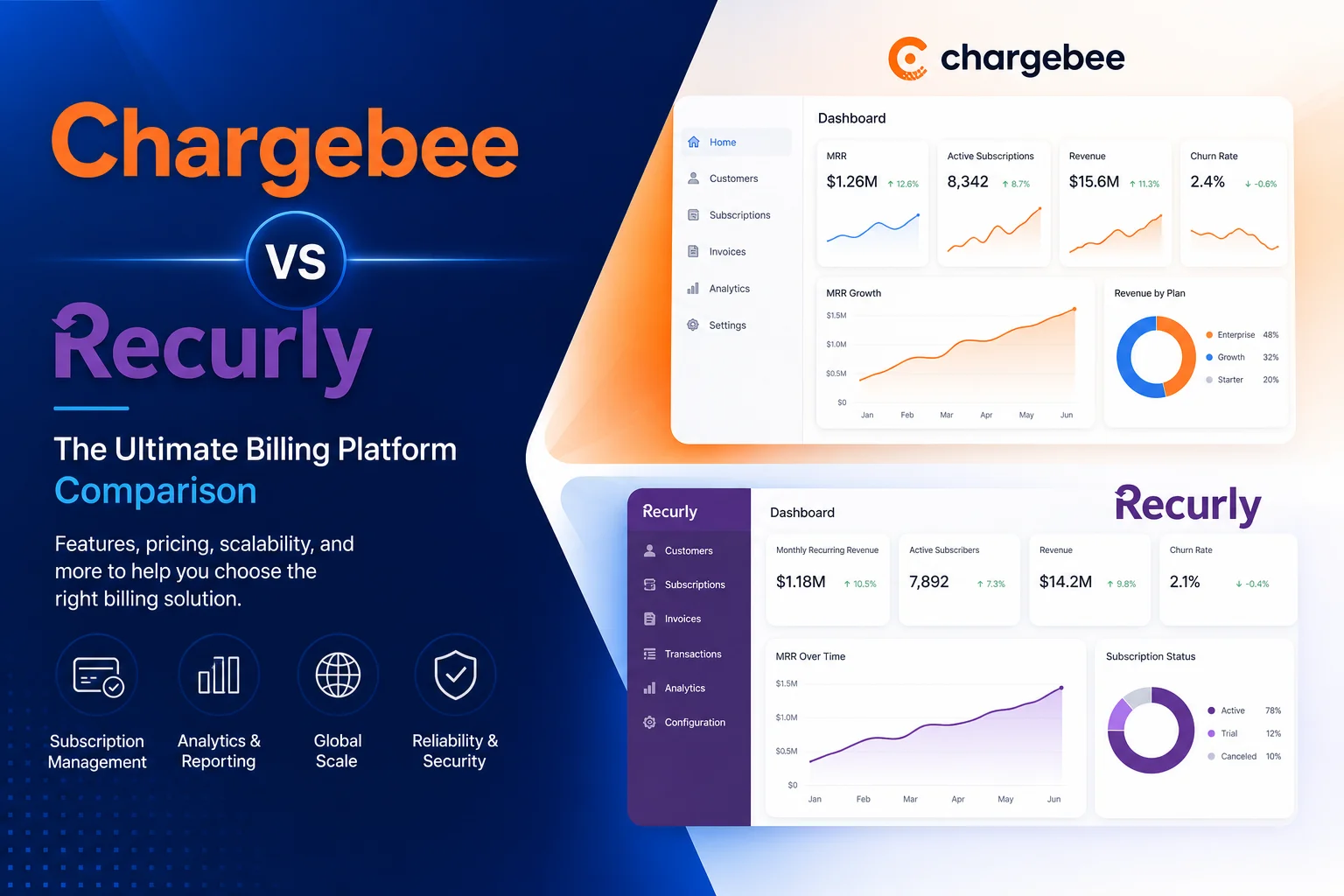
Chargebee vs Recurly: Not Just “Billing” — the Foundation of SaaS Economics
Billing for SaaS isn’t about “sending an invoice.” It’s about: subscriptions, upgrades/downgrades, dunning management (recovering failed payments), trial management, usage-based pricing, global taxes, invoice generation, reconciliation, and 20 more things you don’t want to think about.
Sites: chargebee.com | recurly.com
Chargebee and Recurly are two leaders in the SaaS billing niche. Both solve these problems but approach them from different angles. Let’s break down which tool to choose for your scenario.
Scenario 1: Freelancer Launching a Micro-SaaS ($0–10K MRR)
What matters: low price, quick start, Stripe integration, minimum complexity.
Recommendation: Chargebee
Chargebee offers a free Launch plan — up to $100K cumulative billing for free. For a freelancer just starting out, that’s 12–18 months of free usage. The Launch plan includes: hosted checkout pages, subscription management, dunning emails, coupons, basic analytics.
Recurly has no free plan. The Core starter plan — from $249/month. For a micro-SaaS, that’s unjustifiably expensive.
Verdict: Chargebee — by a wide margin.
Scenario 2: Growing Startup ($10K–500K MRR)
What matters: flexible pricing models, churn/MRR/LTV analytics, integrations, multi-currency.
Comparison:
| Feature | Chargebee | Recurly |
|---|---|---|
| Usage-based pricing | Yes (full-featured) | Yes (more powerful, flexible config) |
| Dunning management | Smart retry rules, email campaigns | AI-driven dunning (Recurly predicts optimal retry timing) |
| Analytics | MRR, churn, LTV, cohort analysis | MRR, churn, LTV + predictive analytics |
| Product catalog | Plans, add-ons, charges | Plans, add-ons, usage charges, custom pricing |
| Global taxes | Yes (Avalara, Vertex) | Yes (Avalara) |
| Integrations | 40+ (HubSpot, Salesforce, Xero, QuickBooks) | 30+ (Salesforce, Netsuite, Xero) |
| API | REST, webhooks, excellent docs | REST, webhooks, good docs |
| Gateways | Stripe, Braintree, PayPal, Adyen, 20+ gateways | 20+ gateways with routing |
Recommendation: depends on priorities
- Priority — dunning and payment recovery: Recurly. AI-driven dunning increases recovery rate by 10–15% compared to Chargebee’s standard retry rules. At $100K MRR, losing 4% to failed payments is $48K/year. Recurly recovers $5–7K more.
- Priority — pricing flexibility: tie. Both support complex models. Recurly is slightly more flexible for enterprise scenarios with custom contracts and staggered pricing.
- Priority — number of integrations: Chargebee. 40+ native integrations vs 30+ for Recurly. For a startup actively adding tools, this matters.
Pricing for this scenario:
- Chargebee: Performance plan — from $599/month (up to 50K MRR) or from 0.75% of MRR
- Recurly: Elite plan — from $699/month + per-transaction fees
Scenario 3: Enterprise ($1M+ MRR)
What matters: scaling, dedicated support, audit trail, custom contracts, security compliance.
Recommendation: Recurly
At the enterprise level, Recurly pulls ahead for three reasons:
1. AI-driven revenue optimization. Recurly uses machine learning not just for dunning, but also for: optimal renewal timing, involuntary churn prevention, LTV prediction. At $10M+ annual recurring revenue, even a 0.5% recovery improvement means $50K.
2. Enterprise features out of the box. Recurly offers: multi-entity management (multiple legal entities in one account), invoice customization to HTML/CSS level, flexible revenue recognition (ASC 606/IFRS 15), custom reporting engine.
3. Gateway scaling. Recurly supports Smart Routing — automatic payment routing through the optimal gateway based on geography, currency, amount. For a global enterprise SaaS, this reduces fees by 0.5–1% across the entire volume.
Chargebee is strong at the enterprise level too (dedicated infrastructure, custom SLAs), but Recurly has been in the enterprise segment longer and has deeper revenue optimization.
Pricing: both — custom pricing, from $2,000/month. Negotiated individually.
Affiliate Programs
Chargebee Partner Program:
- Agencies and system integrators: revenue share from referred clients
- Referral program: 20% of the client’s first-year contract
- Additionally: co-marketing, partner directory listing, priority support
- Partner portal: PartnerStack
Recurly Partner Program:
- 15% recurring commission (while the client pays)
- Focus on agencies and consulting, not content affiliates
- Requirements: active referral pipeline, technical expertise, certification
Affiliate Verdict: Chargebee is more accessible for content affiliates (20% of first year — that’s $1,200–7,200 per enterprise client). Recurly — for agencies implementing billing for clients.
Final Matrix
| Scenario | Recommendation | Key Reason |
|---|---|---|
| Freelancer/micro-SaaS | Chargebee | Free Launch plan |
| Growing startup (dunning focus) | Recurly | AI-driven dunning pays for itself |
| Growing startup (integrations focus) | Chargebee | 40+ native integrations |
| Enterprise ($1M+ MRR) | Recurly | Revenue optimization, multi-entity |
| Content affiliate | Chargebee | More accessible for affiliate content |
Chargebee for starting and growing, Recurly for scale and revenue optimization. If you’re growing — start with Chargebee Launch, and at $500K MRR decide whether to migrate to Recurly.