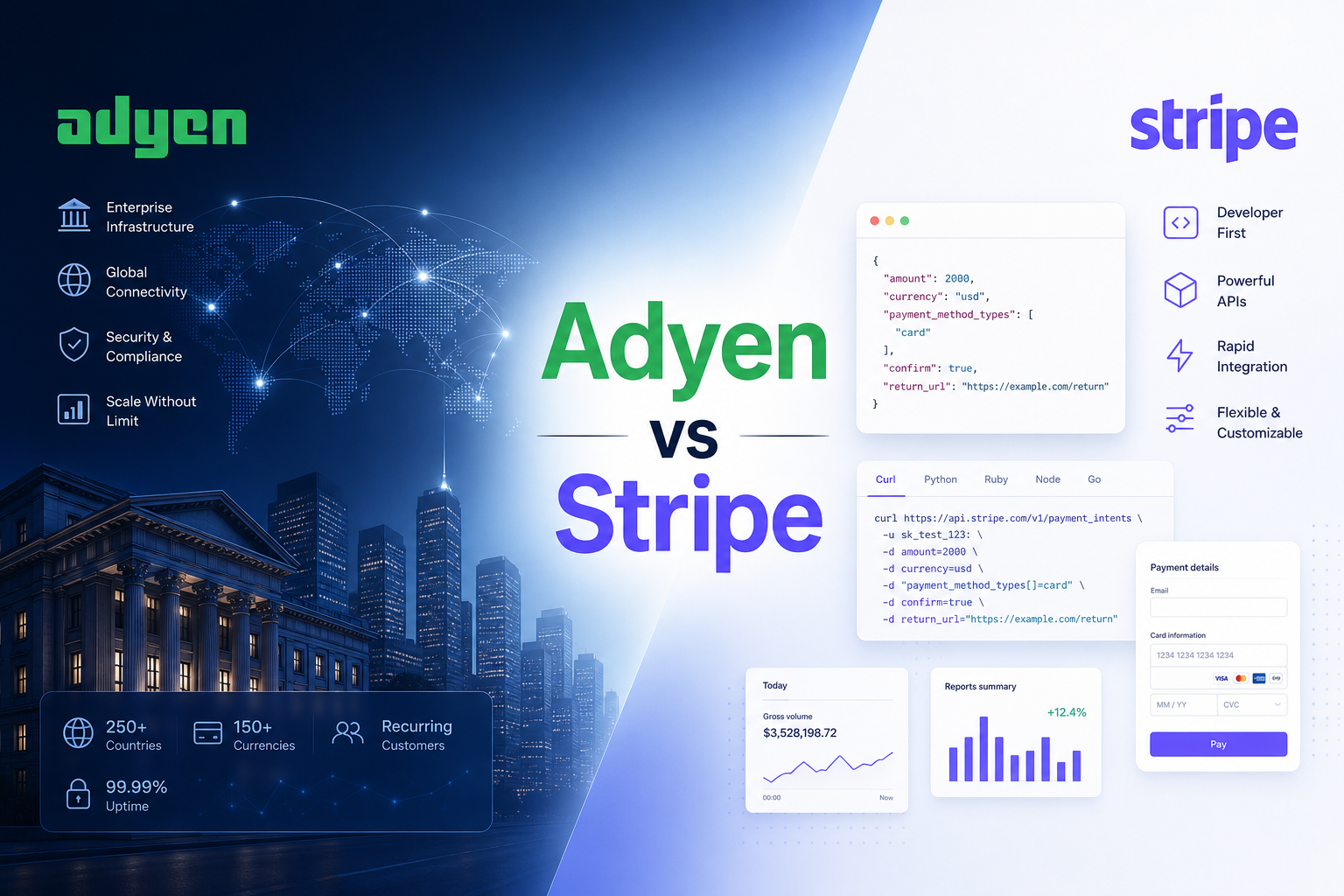
Two Approaches to Payments
Stripe started as an API for developers: seven lines of code, and a payment form is ready. Adyen came from the world of enterprise acquiring: direct contracts with Visa/Mastercard, global banking, white-label payment gateways for Uber, Spotify, eBay.
Over the years, Stripe grew into the enterprise segment (Stripe Connect, Radar, Treasury), while Adyen moved down to mid-market (e-commerce plugins, lower minimums). Today their overlap zones are wider than their differences — but architectural decisions made at the start define their behavior under scale-up loads.
Architectural Differences
Stripe: Developer-First Stack
Stripe is built around its REST API as the core product. Architectural model: one merchant account → Stripe as processor + acquirer.
Merchant → Stripe API → Stripe Gateway → Acquiring Bank → Card Network → Issuing BankStripe acts as an aggregator: it is the merchant of record for card networks, which simplifies onboarding (you can start accepting payments on day one), but creates a single point of risk — Stripe’s compliance issues in one country can affect all merchants.
The technical strength lies in SDKs and documentation. Stripe.js (Elements), Checkout, Payment Links, mobile SDKs — libraries cover virtually any integration scenario. The webhook system is highly detailed (200+ events), and the sandbox environment closely mirrors production.
Adyen: Banking Foundation
Adyen is licensed as an acquiring bank in Europe, the US, Brazil, Australia, and a dozen other jurisdictions. Architecture: Adyen = gateway + acquirer + risk engine in a single loop.
Merchant → Adyen API → Adyen Acquiring (direct) → Card Network → Issuing BankDirect acquiring offers two advantages: lower fees (no intermediary acquiring bank) and faster settlement (funds reach the merchant’s account 1–2 days earlier — at enterprise scale, this means millions in float income).
Adyen uses a single platform approach: all payment methods, all countries, all currencies — through one API endpoint. Stripe is architecturally closer to a modular model: Payment Intents for cards, separate integrations for local methods.
API Design: Comparing Approaches
Stripe — Creating a PaymentIntent:
import stripe
stripe.PaymentIntent.create(
    amount=4999,
    currency="eur",
    payment_method_types=["card", "ideal", "bancontact"],
    metadata={"order_id": "ORD-2024-8842"}
)
Stripe requires explicit specification of payment methods. The client side is handled by Stripe.js — card data never touches the merchant’s server (SAQ-A compliance).
Adyen — Creating /payments:
{
  "merchantAccount": "CompanyNameECOM",
  "reference": "ORD-2024-8842",
  "amount": { "currency": "EUR", "value": 4999 },
  "countryCode": "NL",
  "shopperLocale": "nl-NL",
  "shopperIP": "192.0.2.1"
}
Adyen automatically determines available payment methods based on country and locale settings. The merchant doesn’t specify method types — Adyen shows relevant ones itself (iDEAL for the Netherlands, Bancontact for Belgium, cards for everyone). This reduces complexity on the merchant side for international sales.
Geography & Local Methods
Stripe: 135+ currencies, 40+ countries for merchant registration, 100+ payment methods. But local methods beyond the “big five” (US, UK, EU, AU, CA) often require separate negotiated contracts.
Adyen: direct acquiring in 30+ countries, local payment methods in 40+ countries. Key difference: Adyen has direct access to local payment systems without intermediaries. Pix in Brazil, iDEAL in the Netherlands, Bancontact in Belgium, AliPay/WeChat Pay — all through a single API without additional contracts.
For a merchant selling in 10+ countries, the complexity difference between Stripe and Adyen can amount to hundreds of engineering hours.
Fees: Why Head-to-Head Comparison Doesn’t Work
Stripe: 2.9% + $0.30 for US cards (standard plan), 1.5% + £0.20 for UK cards, 1.5% + €0.25 for EU cards. Plus 1.5% for international cards and 1% for currency conversion.
Adyen: rates are not published on the website — each merchant gets individual pricing. Rough estimate: €0.10 fixed + 0.3–1.5% depending on volume, country, and risk profile. Plus interchange (card network fee) as pass-through.
Fundamental Pricing Model Difference:
- Stripe: blended rate (everything included in the percentage)
- Adyen: interchange++ (interchange + scheme fee + acquiring fee separately)
Blended rate is simpler for accounting and predictability. Interchange++ at volumes of €100K+/mo saves 0.3–0.8% — a difference measured in tens of thousands of euros per year.
Example calculation: €1M/mo in EU transactions. Stripe: ~€15,000 in fees. Adyen (interchange++): ~€11,000 — saving €48,000/year.
Risk Management & Fraud Prevention
Stripe Radar — ML-based fraud detection, included in the price. Customizable rules, block/allow lists, risk scoring. Sufficient for 80% of businesses.
Adyen RevenueProtect — also ML-based, but with deep customization of risk rules for each merchant. Uses data from closed schemes (Visa/Mastercard network intelligence, unavailable to Stripe) plus cross-merchant signals from platforms at Uber and Spotify scale.
For high-risk industries (gaming, crypto, travel), Adyen provides finer control over risk thresholds and fewer false declines.
Affiliate Programs: Comparison
Stripe Partner Program:
- Three tiers: Registered, Silver, Gold
- Revenue share for referred merchants (depends on tier)
- Certification, co-branding, priority support
- Partner earns a percentage of the referral’s processing volume
Adyen Partner Program:
- Technology partners and referral partners
- Referral fee for enterprise deals (fixed amount or %)
- Co-marketing, listing in partner directory
- Each deal is negotiated individually due to enterprise specifics
For a partner with a developer and startup audience, Stripe offers a more predictable pipeline. For a partner with access to enterprise merchants (€500K+/mo turnover) — Adyen can bring significantly higher one-time income per deal.
When to Choose Which
Choose Stripe if:
- You’re a startup or mid-market (turnover up to €500K/mo)
- Integration speed and fee predictability matter
- Your dev team values SDKs and documentation
- You need MoR mode (Stripe as reseller) — for marketplaces
Choose Adyen if:
- Turnover from €500K/mo — interchange++ savings become significant
- You sell in 10+ countries with local payment methods
- You want direct acquiring and faster settlement
- You need deep fraud detection customization for your risk profile
- White-label matters (end-to-end control over checkout flow)
Hybrid Approach: some companies use a combination — Adyen for core acquiring + Stripe for niche payment methods and testing new markets. This is harder to maintain but provides flexibility and hedges dependency risk on a single provider.
Official websites: stripe.com and adyen.com. EN_ADYEN_STRIPE" 2>&1